The US endurance racing ladder.
From a rental kart to Le Mans, endurance racing is the same race at every level. A 2026 map of every level you can start on, and where a newcomer called Zenith fits.
Endurance racing has never been more accessible. You can start at the very bottom tonight, three friends and a rental kart and a hundred dollars each, and the race they will run at Le Mans next June is roughly the same one: a driver change, a fuel plan, and long stints where nobody wins in a single lap. Nearly every rung of the US endurance racing ladder between the kart and the Le Mans car exists.
Mapping the endurance racing ladder in 2026 is harder than it sounds, because all of the good references are old. There’s plenty written about the 24 Hours of Lemons, and in 2017 Petrolicious called the World Racing League “the perfect affordable racing series.” That world has moved on, and we could find almost nothing describing the endurance racing ladder as it actually stands in 2026, and nothing mapping the whole of it, kart to Le Mans, with a newcomer like Zenith placed on it. So we asked Gino Manley, who has raced most of the grassroots ladder, ChampCar, AER, WRL and Lucky Dog among them all the way up to the Nürburgring 24, and we mapped the rest ourselves.
Where you can start
These days the ladder starts in the virtual world, in a sim rig at home, where a wheel, a set of pedals and an iRacing subscription puts you in the same cars and the same long races for a few hundred dollars. You can even race against the real-life drivers who are winning the real-life series virtually. More than a few top-level drivers have started in sim racing.
In the physical world it starts below cars. Karting tracks across the world run arrive-and-drive enduros, teams sharing karts for a few hundred dollars per person, no racing licence and no maintenance necessary. It is the cheapest wheel-to-wheel racing there is, and it already has the same outline of the real thing: timed stints, pit stops, and a car you hand to someone else. The cheapest way into an actual car is the 24 Hours of Lemons, where the machines are meant to cost five hundred dollars, safety equipment not included, and the prizes reward the best joke as readily as the best result. The grid is a costume party that learned to corner, and that is the entire appeal. It might be the most fun you can have with a roll cage.
Above that is the broad base of the sport: the production-car endurance leagues. ChampCar, formerly ChumpCar, Lucky Dog Racing League, American Endurance Racing and the World Racing League run budget and club cars up to GT4-class cars in long multi-class races, six and eight and fourteen hours of them, and NASA’s 25 Hours of Thunderhill stretches the idea into the longest closed-course race in the country. This is where most American endurance drivers actually are, thousands of them, racing hard for the price of a used car and a set of tires, a few of them quietly excellent, and most of them exactly where they want to be. It is also where the ladder stops being a tidy line, because a club grid here can hide professional-class drivers spending a weekend off for the fun of it.
It is the rung Gino Manley still swears by, even after climbing it all the way to the Nürburgring 24.
Of the series around where Zenith stands, the World Racing League comes closest. WRL runs purpose-built prototypes and GT4 cars alongside its production classes, split by a power-to-weight formula much like the one Zenith uses, so the two grids can look strikingly similar. The difference is the body around the racing, rather than the cars in it. Zenith adds a sanctioning body, prize money, and a road pointed at the professional ranks of IMSA and SRO. That is where Zenith has slotted in: faster and more serious than most of the club leagues, a fraction of the cost of the pros above, and built, unlike the grassroots leagues it was born from, as a pipeline.
Then the ladder turns professional, and from here every rung is another step up in both pace and cost. The first paid tier is IMSA’s VP Racing Challenge, with SRO’s GT World Challenge America alongside it: pro-am fields where a paying amateur, bronze-rated, shares a car with hired silver, gold or platinum professionals. A clear step above sits the Michelin Pilot Challenge, faster machinery and deeper fields for bigger budgets again. Above that is the WeatherTech SportsCar Championship, the GT3 cars and GTP prototypes on national television, where the budgets run into the millions. None of it is a sideways move; each rung asks for more money and more speed than the one below. And the whole structure points, in the end, at the World Endurance Championship and the 24 Hours of Le Mans, the 24 Hours of Daytona, and the 24 Hours of Spa. The same race as the rental kart, scaled up by a thousand times the money.
Where does Zenith Racing Series fit?
Placing a new endurance racing series on it takes a full deep dive: who is in the cars, what a weekend costs, and what everyone is racing for. We asked these questions of the Zenith Racing Series, a first-season American multiclass championship.
Who shows up
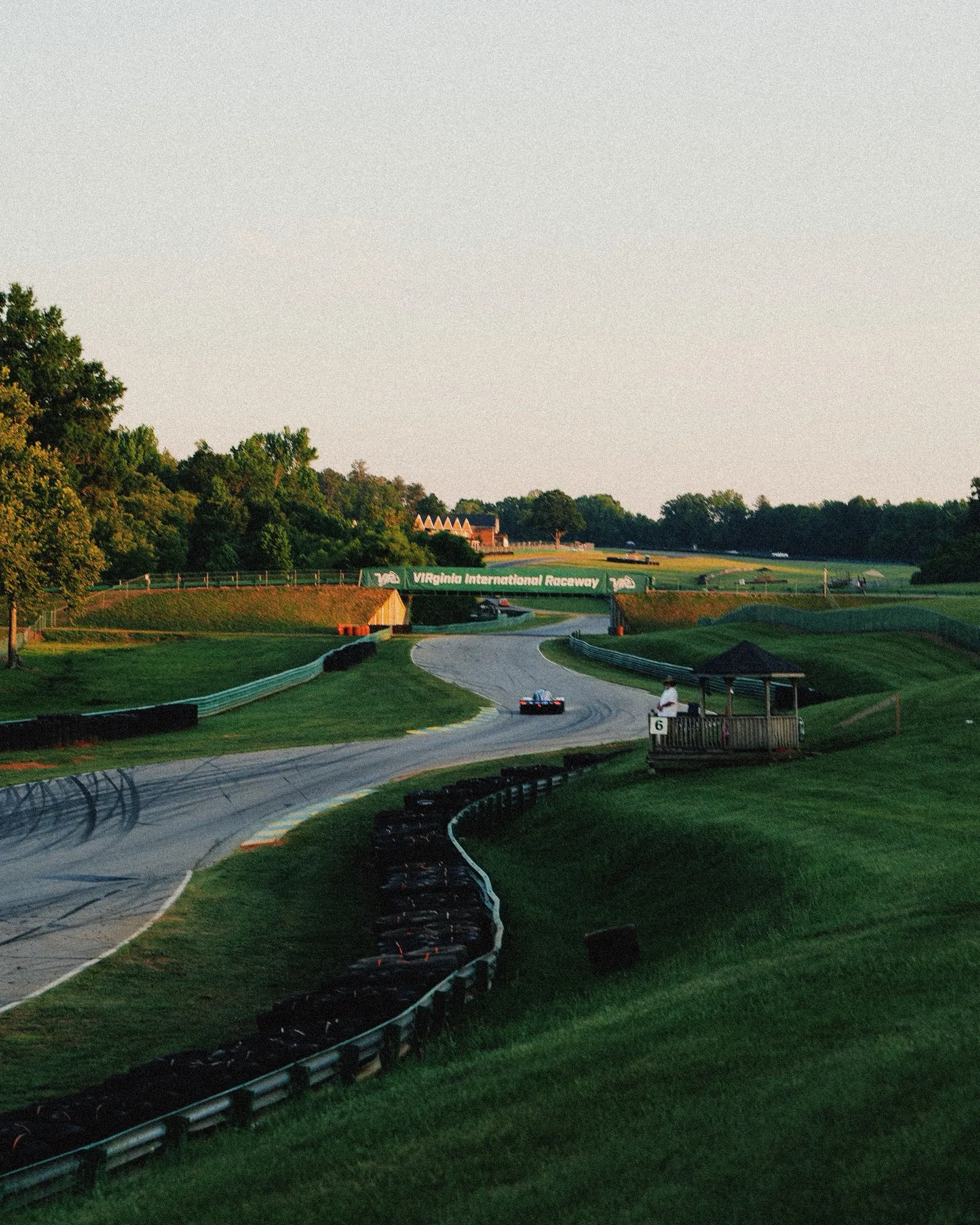
Starting with the drivers: We looked at eighty-eight drivers across three classes at the Zenith Racing Series’ most recent round in Virginia.
The credentials run all through the field, not just the front: an IndyCar Rookie of the Year, a Formula 4 champion, a NASCAR Xfinity driver, one of the world’s highest-rated sim racers, sportscar pros with twenty-four-hour race wins, and, in the winning car, the co-CEO of Oracle. Nineteen drivers hold an FIA grade, the ratings required across IMSA and WEC. And that was one race, not the whole championship. Hunter Yeany, a US Formula 4 champion and FIA Formula 3 driver in his own right, holds Zenith points, as does Hampus Ericsson, the brother of an Indianapolis 500 winner.
With some serious names like that, we set the grid beside a professional one. The IMSA VP Racing Challenge is American sportscar racing’s entry-level pro series, a rung below the Pilot Challenge: paid, and rated top to bottom, the rulebook grading every driver to balance the field. Here it is, at Mid-Ohio, beside the Zenith field at VIR.
The full classification is with the recap.
The full result Every car, every driver at VIR Finishing order, laps, FIA grades and a dossier on all eighty-eight drivers, in the Dead Heat recap. See the full VIR result →What it costs
A ZP2 prototype weekend runs $15,000 to $20,000 all-in; a production ZR3 weekend, less. That is real money, well above a club enduro, but a fraction of the next step up into IMSA and a fraction of the single-seater path, where a Formula 4 weekend alone costs more than a Zenith prototype one and Formula 3 costs ten times as much.
What a race weekend costs
Sim racing is a one-time rig cost, the only rung you climb without leaving home. The rest are rough per-weekend figures, all-in, from 2026. The grassroots entry fees are published and firm; the professional and single-seater tiers are order-of-magnitude more expensive. The bar is a log scale, so each step right is a multiple, not an addition.
What it’s for
Cheap series carry good drivers, and expensive ones do too. What separates them is what the racing is for.
Take the World Racing League. It is similarly cheap to run, yet its champions include NASCAR Cup and Xfinity racers, and its paddock holds full IMSA operations, some arriving on semis with hospitality decks. Despite the professional-level racing, the results carry no prize money: the people who race it are there for the name of the championship alone. Let’s be clear: Winning in World Racing League is no small feat. Its champions have gone on to win in IMSA, proving it as a battle ground for tomorrow’s top racing champions. Zenith, while positioned similarly, differs in that it’s USAC-sanctioned, Al Kamel-timed, and runs a million-dollar awards program pointed at IMSA. The same kind of field, but racing for different stakes. That is the design of a pipeline: a serious field, real money, and a road pointed at the professional ranks. The pull is real, too. Linus Lundqvist, the 2024 IndyCar Rookie of the Year, turned out for the VIR twelve-hour, and he’s not the only FIA gold. What the design does not have yet is a proven record. This is the first season; no champion has been crowned, let alone gone on to win in IMSA. Whether the ladder Zenith points at actually carries its best drivers up is the open question, and is the reason to watch it closely. For now it is a pipeline by design, not yet by proof.
The other open question is where Zenith and WRL go from here. The world of racing has seen sanctioning bodies split before. The split divides the grid and the drivers into two championships, both of them weaker, until the two merge again or one folds. Which way Zenith and WRL go, this first season won’t settle.
Where it sits
Read Zenith by the three questions instead. Who shows up is a pro-grade field. What it costs is close to a club one. What they are racing for, for a good number of them, is a way up. That makes it a licensed racer’s proving ground, pointed at the professional ranks, with the field and the money to mean it. Whether it carries anyone the rest of the way is the question its first season leaves open, and one that much like endurance racing as a whole, only time can tell how it ends.
Driver debriefs, race dispatches, the story told from inside the helmet, by email.
Dead heat.
Round 3 of the Zenith Racing Series, the twelve hours at Virginia International Raceway: ninety degrees, most of the field's coolsuits dead by mid-afternoon, nine of twenty-eight cars gone before the finish. Stratus won it by sixty-two seconds over the car that set the fastest lap of the day, and left the two ZP2 championship contenders dead level at the top.
Follow the season live
Standings, the weekend schedule, and the broadcast when a session is on track.