A car guy first.
A Florida car salesman who never raced a kart, crowdfunded his way onto an IMSA grid at Daytona, and went viral flogging a rental minivan flat-out. Gino Manley on the green $5,000 hatchback that made his name, the lap of the Green Hell he'll never forget, and why he's a car guy long before he's a racer.
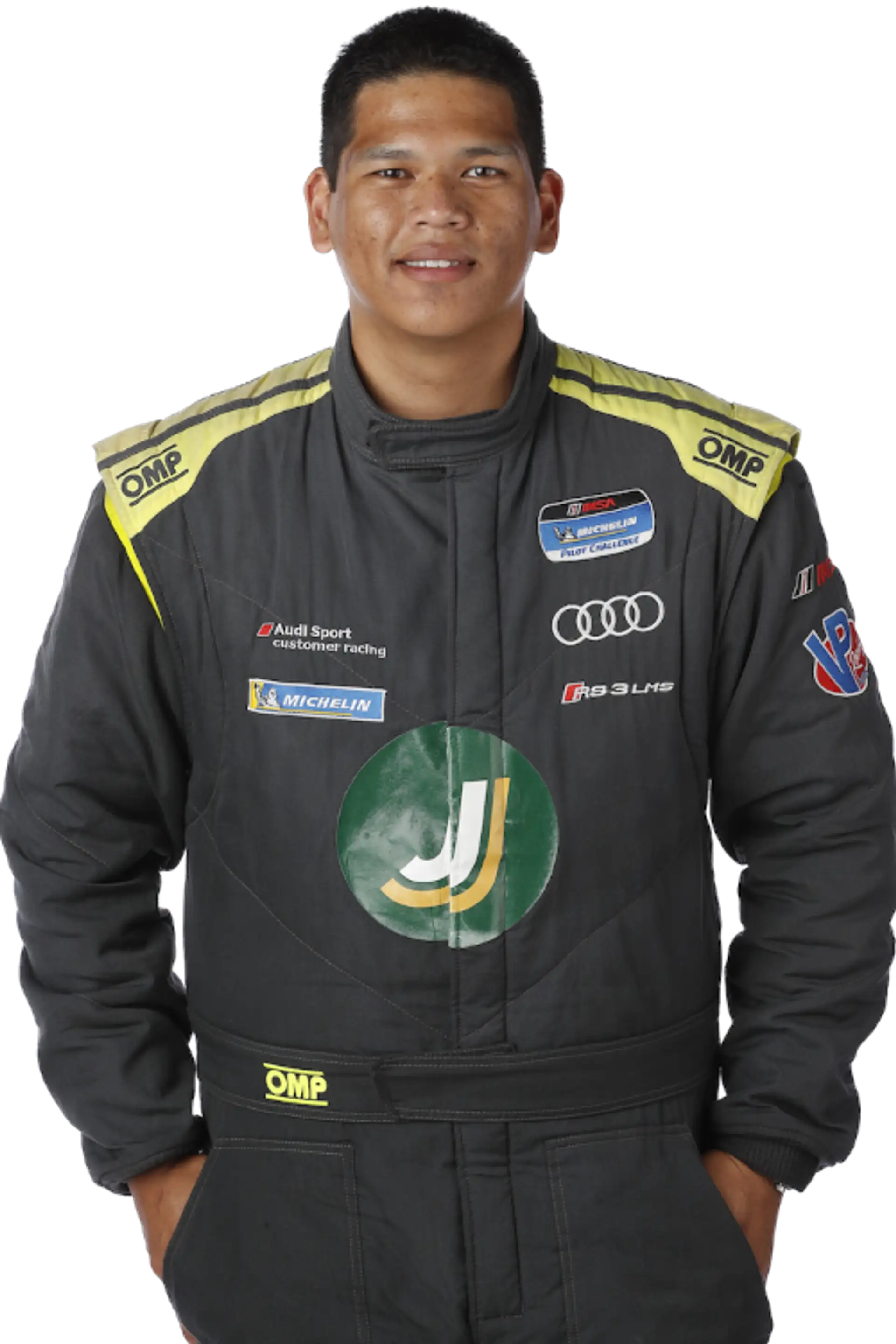
Gino Manley never raced a kart. He never went to a racing school. He is the general manager of Tom Bush Mazda in Jacksonville, Florida, and by his own account a car enthusiast first and a racer second. “If there’s a helmet involved, I’m usually happy to be there,” he says. The first wheel-to-wheel race of his life was a ChampCar enduro in a 1988 Volkswagen Golf that made maybe a hundred horsepower on a good day.
That résumé should have stopped at the club level. Instead it kept climbing. He talked and drove his way up through autocross and ChampCar into a factory-built Audi TCR in the IMSA Michelin Pilot Challenge, and when the funded co-drives fell through for his home race at Daytona, his friends and family simply crowdfunded the entry. Since then, he has raced the 24 Hours of the Nürburgring and the Bathurst 6 Hour. He also went briefly internet-famous for flogging a rental Chrysler Pacifica flat-out around Road Atlanta, quick enough that the people who built the van wrote to him about it.
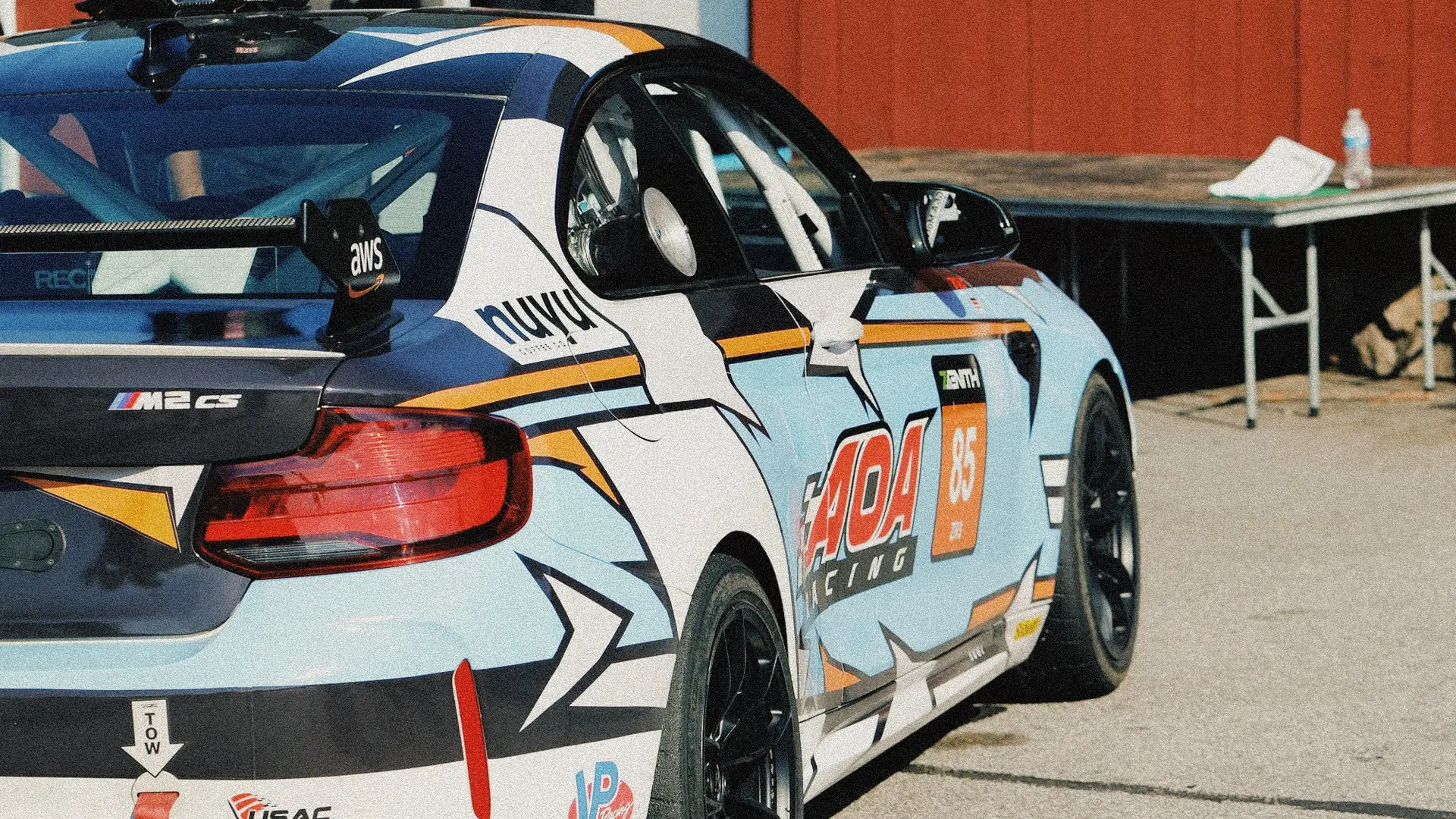
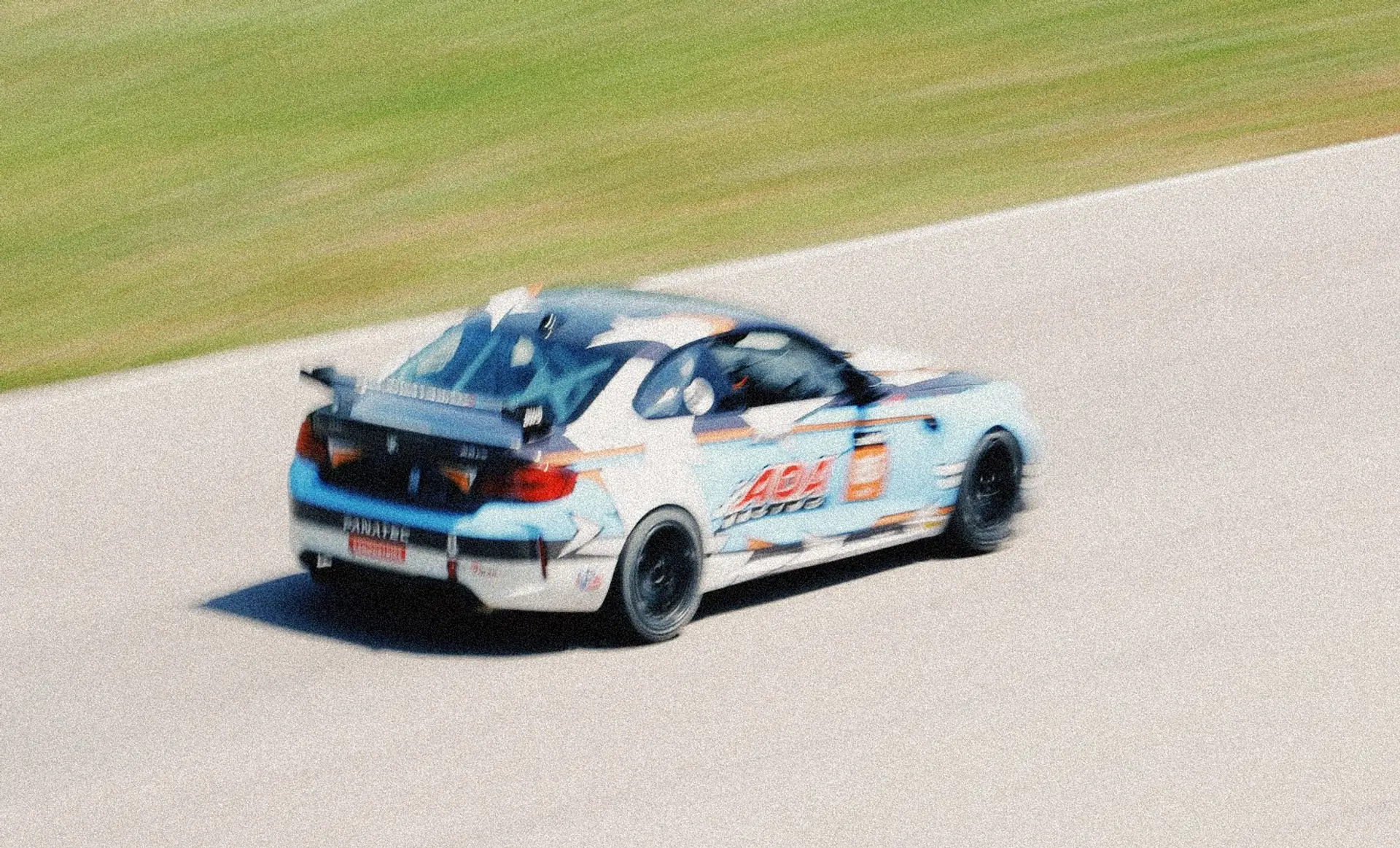
Now he runs the #85 AOA Racing BMW M2 CSR in Zenith’s ZR3, the production-GT class, sharing the car with Clifton Lipple and Alex Pollard. We asked him to tell it from the beginning.
The Debrief
The basics: where you’re from, what you race, the cars.
My name is Gino Manley, and I’m from Jacksonville, Florida. By day, I’m the General Manager of Tom Bush Mazda, but I’ve always been a car guy. Racing has been a passion of mine for as long as I can remember, so being able to live that dream is something I never take for granted.
These days, I’m fortunate to race with several great teams in a variety of cars. In the U.S., I primarily compete in a BMW M2 CSR with AOA Racing, an Atlanta-based team. I also race a pair of E92 BMW M3s with my good friend Mike Gorman and Open Throttle Racing. When I’m in Europe, I compete in the Nürburgring RCN Series in a Clio Cup car, and whenever the opportunity comes up, I’ll jump into a BMW M240i Racing as well in the NLS. This year was especially memorable because I had the opportunity to travel to Australia and compete in the Bathurst 6 Hour for the first time. Racing at Mount Panorama had always been a bucket-list experience, so being able to check that off was incredibly special.
Outside of competition, I spend a lot of time at track days with my home track group, Jzilla Track Days. At the end of the day, I just love being at the racetrack. Whether it’s racing, testing, or simply driving whatever’s available that weekend, if there’s a helmet involved, I’m usually happy to be there.
How’d you get into endurance racing? You never raced a kart or went to a racing school, and your first wheel-to-wheel race was a ChumpCar enduro. How does someone start there?
I didn’t really get into competitive motorsports until I was 18. At the time, I was a young salesperson at a dealership when a Volkswagen Golf R32 got traded in. I’d always been a car enthusiast, and there was just something about that car that I had to have, so I bought it. Not long after, I discovered SCCA autocross and decided to give it a try as a novice. I was hooked from the very first event.
For the next two or three years, I threw myself into autocross. I eventually transitioned into a Miata, became pretty competitive, and traveled all over the Southeast competing. Looking back, those years taught me a tremendous amount about car control and introduced me to an incredible community of people. A few friends I met through autocross and I decided to pool our money together and enter our first ChampCar endurance race in a 1988 Volkswagen Golf. The car made maybe 100 horsepower on a good day, so it certainly wasn’t the fastest thing on track, but it gave me my first taste of wheel-to-wheel racing. That experience completely changed the direction of my life.
I still think ChampCar is one of the best entry points into endurance racing. When I started, arrive-and-drive programs were just beginning to become popular. Today, there are teams like Mike Gorman’s Open Throttle Racing and many others where you don’t even need to own a race car. There are entire websites where you can reserve a seat in a race with little or no prior experience.
I never spent much time in traditional club racing, and I think that’s a great path for a lot of drivers. But if I were starting over today and spending my own money, I’d still choose one of the grassroots endurance series. You get a tremendous amount of seat time, learn how to race in traffic, work as part of a team, and, just as importantly, you end up around the right people. So much of this sport comes down to the relationships you build, and those connections have opened doors for me that I never imagined. When I look back, it’s amazing to think that everything really started with a used Golf R32, a local autocross, and a beat-up endurance race car.
Five years ago you wrote that your lime-green Mazda2 was the only reason you’d made it as far as you had, and then called it a story for another time. This is another time. What’s the story?
While I was doing quite a bit of autocross and starting to run a few ChampCar races, one of the most competitive autocross classes at the time was a front-wheel-drive class called STF. I bought a little Mazda2 with the intention of building it into a competitive autocross car. The funny thing is, around that same time I was really starting to fall in love with road racing. I was transitioning away from autocross and spending more time doing HPDEs and track days. Since I already owned the Mazda2 and didn’t have much of a budget, I figured I’d just use that car on the big tracks.
So I started taking it to places like Road Atlanta, Charlotte Motor Speedway, and Barber Motorsports Park. I signed up with Jzilla Track Days, and honestly, I mostly kept to myself. Here I was in this little economy hatchback surrounded by Corvettes, Porsches, and purpose-built track cars. After a while, though, people started to notice that the little Mazda2 was running surprisingly well. I was able to keep a pretty good pace in the advanced run group, and it became a bit of an underdog story.
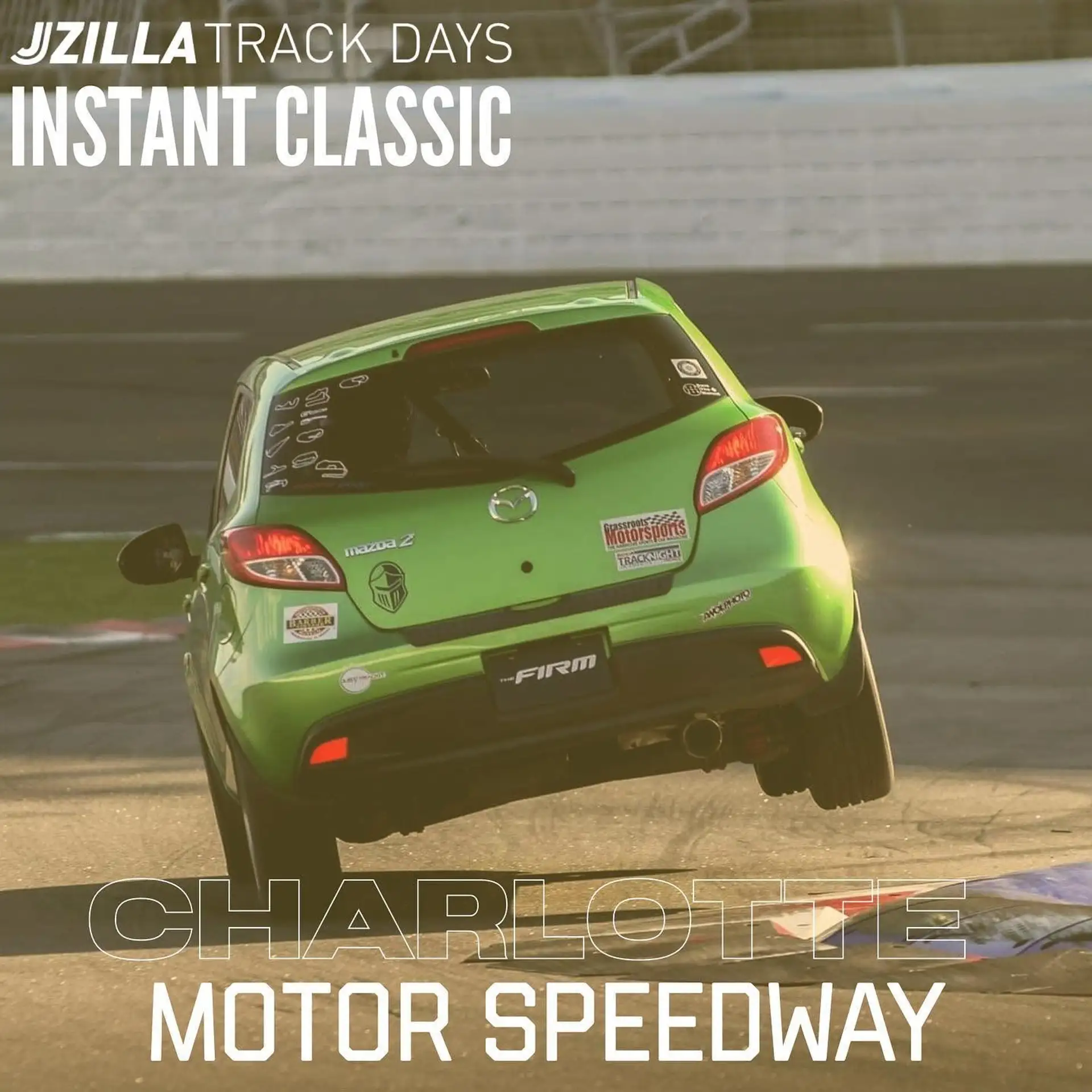
The turning point came during a night event at Charlotte Motor Speedway on the Roval. Photographer Chad Burdette captured a photo of the car launching over the front chicane, and that image kind of took on a life of its own. It spread around the track day community, and before long Jzilla made a run of T-shirts with the picture and the slogan, “This is Gino. Be like Gino.” I think it resonated because it showed that you didn’t need a GT4 RS or a six-figure track car to have fun or be fast at a track day. You could show up in a $5,000 economy hatchback, drive it well, and earn the respect of everyone around you.
Looking back, that little Mazda2 probably did more for my racing career than any race car I’ve ever owned. It introduced me to people throughout the motorsports community, led to friendships with drivers and team owners, and ultimately opened doors to opportunities I never could have imagined. What’s crazy is that it wasn’t even two years after driving that little economy hatchback around at track days that I was strapping into a factory-built Audi RS3 LMS TCR at Road Atlanta for my first IMSA Michelin Pilot Challenge start. It all happened incredibly fast, and when I look back, it really was a wild ride.
You ran the 24 Hours of the Nürburgring in 2025, then said a flat-out lap in a rental Chrysler Pacifica was your best drive of the year, and the engineers who built the van wrote to you about it. Tell us about that one.
It’s funny because I think there are really two types of drivers. There are people who love racing and want to be race car drivers, and then there are people like me who are genuinely car enthusiasts first. I absolutely love cars—all kinds of cars—and racing has simply given me the opportunity to experience vehicles that most people never get to drive.
Because of that, I’ve always enjoyed taking something that was never intended for a racetrack and seeing what it can actually do. So when we took a rental Chrysler Pacifica to Road Atlanta, it honestly started as a joke. It was meant to be a satire video poking fun at all the lap record videos you see online. The funny part is that once we filmed it, it looked so serious that people thought we were actually trying to set a record. The response was unbelievable.
What surprised me most was how many people reached out saying the video inspired them because it proved you don’t need a Porsche GT3 or a purpose-built race car to enjoy a track day. In the HPDE world, I hear people say all the time, “I’ll come out once my car is finished,” or, “I’ll do it when I can afford the right car.” That video showed you can have fun and learn with just about anything.
The biggest surprise, though, was hearing from Chrysler Staff. I had engineers from the Pacifica program reach out to me personally. Many of them were motorsports enthusiasts themselves, and they started telling me stories about the development of the van—how much time they spent trying to make it handle well, how they tested it on racetracks, and all the compromises they had to make because comfort and family usability always had to come first. Some of them even joked that the van could have been quite a bit quicker if management had let them make it a little less comfortable.
As a car enthusiast, that was honestly one of the coolest parts of the whole experience. Most people will never appreciate the work that goes into engineering something as ordinary as a minivan. To have the actual engineers reach out and say they were proud that someone had finally shown what the chassis was capable of—that meant more to me than the lap itself. Ironically, I raced the 24 Hours of the Nürburgring that same year, one of the biggest endurance races in the world. Yet one of my favorite drives of the entire season ended up being a flat-out lap around Road Atlanta in a rental Chrysler Pacifica. On paper, that makes absolutely no sense. But if you’re a true car enthusiast, it makes perfect sense. I made the people who built the damn car proud.
Time goes weird in a long stint. What do those hours in the seat actually feel like: faster, slower, gone?
It really depends on how the race is going. Time in an endurance race is almost completely mental. I’ve been in the car leading a race on a 100-degree day where it was so hot I could barely breathe. You’d think that would feel like forever, but when you’re out front, the car is doing exactly what you want, and you’re completely in the zone, time just disappears. Before you know it, the radio comes on and they’re telling you to box because your stint is over.
On the other hand, if the car isn’t handling well, you’re fighting for grip, or maybe you’re driving a damaged car because one of your teammates had an incident earlier in the race, a one-hour stint can feel like four. You’re constantly working around problems, counting laps, and willing the clock to move faster.
The physical side is demanding, but the mental side is what really changes your perception of time. When everything is clicking, you almost don’t remember the stint afterward because you’re so focused. When things are going badly, every lap feels longer than the last. That’s endurance racing. The stopwatch always moves at the same speed, but inside the cockpit, it can feel completely different depending on what kind of day you’re having.
You once wrote a whole section on how much you hate the driver change, the second workout, forty seconds, gloves on, nobody able to hear a thing. Still the worst part of the job? Or have you made your peace with it?
The short answer? No lol. I still hate driver changes. People think the hard part is driving the car, but sometimes the most stressful 30 or 40 seconds of an endurance race happen in pit lane.
Imagine climbing out of a race car after two or three hours. You’re exhausted, your heart rate is still up, it’s 120-plus degrees inside the cockpit, you’re trying to unplug radios and drink tubes, disconnect the steering wheel, get out without getting tangled in the window net, and all of this is happening while the next driver is trying to climb in. Nobody can really hear each other over the engines, everyone is wearing helmets, and every second matters. Then if you’re the driver getting in, your visor fogs up immediately because the cockpit is so hot, you’re trying to find the belt buckles with gloves on, get everything tightened correctly, plug in the radio, and do it all quickly without making a mistake. It’s controlled chaos.
I still don’t enjoy that part of endurance racing, but it’s part of it. The higher the level of competition, the more seriously you treat it. Before important races we’ll rehearse driver changes over and over until everyone knows exactly what they’re doing. It’s one of those things that looks simple from the outside, but races have absolutely been won and lost in pit lane because of a sloppy driver change. I still hate doing them…but I definitely respect how important they are.
The Daytona run is the one people tell about: co-drivers said screw it, let’s just crowdfund it, parents and friends chipping in small dollars, the president of IMSA himself, John Doonan, waving your late entry through because he said IMSA needs more of this. Take me back to that weekend, and what it means to you now.
To be completely honest, if it weren’t for all the photos and videos, I don’t know if I’d believe the story myself anymore. It almost sounds made up. It’s been pretty well documented how we got there. We were a true grassroots team. There wasn’t a big manufacturer behind us or a huge budget. Family members chipped in, friends chipped in, teammates chipped in—we basically crowdfunded our way onto the grid at Daytona. Even getting accepted into the race took some faith from IMSA. John Doonan believed our story deserved a chance, and I’ll always be grateful for that.
The moment that sticks with me happened early in the race. I was in the car during my first stint under caution, and I happened to look at the leader light of the car in front of me. I realized it said “3.” I keyed the radio and asked Pinkerton, “Are we really running fourth right now?” There was this long pause, and then in the calmest voice imaginable he just said, “Yeah.” I don’t think either one of us really believed it.
For a good portion of that race we were running at the sharp end of the field against teams with budgets that absolutely dwarfed ours. I still remember passing every factory Hyundai in the race with an old car that had a billion kilometers on it. It was one of those moments where you stop thinking about what you’re supposed to be capable of and just drive.
Looking back now, that weekend meant so much more than the result. It proved something to me. Up until then I’d always wondered if I really could survive at that level or if I would fold. Daytona gave me the confidence that, when the visor goes down, I might just be a car salesman from Florida, but in a pinch, I could probably keep up. I leaned on that confidence many times afterward, especially when I started racing in Europe. Whenever I found myself questioning whether I belonged, I’d think back to Daytona and remind myself, “You’ve done this before. You’ll be okay.”
The other thing that makes that weekend so special is the people. Almost everyone involved with that program is still one of my closest friends today. We went through something together that none of us will ever forget. Every now and then someone will come up to me and say they remember watching that race, or I’ll stumble across an old photo from that weekend. It reminds me that, every once in a while, motorsports still produces a true underdog story. We were just a bunch of regular people who refused to believe we didn’t belong. When I think back on Daytona, I remember moments where I honestly thought, “We probably shouldn’t be pulling this off.” But we did. And I know that when my racing days are over, that weekend will always be one of the first stories I tell.
Every driver has a moment they replay. Is it the P7 at Sebring, the anthem on the grid at Road Atlanta, the Pacifica lap, something at the Nürburgring, or something nobody would guess?
For me, it has to be the 24 Hours of the Nürburgring. I’ve driven a lot of laps around the Nürburgring over the years, so I know the track pretty well. But the one thing I’d never really experienced was driving it at night. Before the race, we had a couple of scheduled night practice sessions. Unfortunately, the session I was supposed to drive was cut short because our BMW had an electrical issue. So when race day came around, my very first nighttime lap of the Nürburgring wasn’t in practice—it was at one o’clock in the morning during the biggest race of my life.
I remember leaving pit lane thinking, “This is probably going to be okay…” and then almost immediately realizing how dark it actually was. You quickly understand that your headlights don’t show you very much of the track. I had to calm myself down, trust my memory, and settle back into the rhythm of the circuit. For the first few laps, I kept telling myself one thing: Don’t make a mistake. The GT3 cars close on you so quickly in the dark that your biggest fear is turning in just as one appears beside you. You have to completely trust your mirrors, your instincts, and your awareness.
After a few laps, though, something changed. The fear faded, and I found a rhythm. Then I started to notice everything around me. There are moments on the Nordschleife where you’re completely alone. It’s just you, your headlights, and miles of forest. Then you look beyond the Armco and realize there are over 250,000 people out there. You can see campfires glowing in the woods, smell people barbecuing in the middle of the night, hear fireworks going off in the distance. It feels like you’re alone, but at the same time you’re surrounded by this incredible energy.
One thing I’ll never forget is the BMW fans. Driving a BMW at the Nürburgring is a little like driving a Corvette at Daytona. Every single lap there was a fan standing trackside waving a giant BMW M flag as I drove by. It sounds like a small thing, but it made you feel like you were part of something much bigger than yourself.
When I think back on that stint, I remember the emotions more than anything. I went from being genuinely scared, to completely focused, to eventually realizing I was living one of the coolest moments of my life. I’ve had some incredible experiences in racing, but I honestly don’t know if I’ll ever be able to replicate the feeling of driving through the Green Hell at one in the morning with nothing but my headlights, a quarter-million fans in the forest, and the realization that I was exactly where I’d always dreamed of being.
What’s the part of endurance racing that keeps you coming back?
For me, it’s always been the cars and the people. Some of my favorite memories in racing didn’t actually happen on the racetrack. They happened in the paddock—laughing with teammates while trying to fix a problem at midnight, making an emergency run to an auto parts store, or sitting around a table after the race at some little restaurant in a town you’ve never heard of. Those are the moments that stick with you.
And then there are the cars. I’ve been incredibly fortunate to drive some amazing machinery and compete in races that I used to only watch on television. But what’s funny is I still have just as much fun at a grassroots ChampCar race with a group of friends as I do at an international event like the Bathurst 6 Hour or the 24 Hours of the Nürburgring. To me, the joy has never really depended on the budget or the prestige. It’s always been about the experience.
I never lose sight of the fact that I’m still living the dream I had as a kid sitting on the couch playing Gran Turismo. Every time I buckle into a race car—whether it’s a factory-built touring car or an old endurance car built in somebody’s garage—I still have that same feeling. I think that’s what keeps me coming back. It’s not chasing trophies or trying to prove something anymore. I just genuinely love cars, I love the people this sport has brought into my life, and I still can’t believe I get to do it.
You’ve said you’ll never be a paid pro or race a prototype, and you sound genuinely at peace with that. So what’s a series like Zenith for you, and what do you still want out of racing?
I’ve made peace with the fact that I’ll probably always just be a pretty good amateur, and honestly, I’m okay with that. I’ve spent enough time around the professional paddock to realize that it’s a different world, pretty toxic actually. For some people it’s the dream, but I actually enjoy the atmosphere of amateur racing a little more. The passion is different. People are there because they genuinely love the sport, and that’s always resonated with me.
That’s one of the things I really like about Zenith. It gives you so many of the things you experience at the professional level. The technology is impressive, the cars are fantastic, and the officiating by the USAC officials is outstanding. They’re incredibly professional but also approachable, and I think that makes a huge difference. The timing and scoring system is as good as anything you’ll see in IMSA, and the whole series has a level of polish that really stands out. I also like the mix of prototypes and touring cars. It teaches traffic management and racecraft without creating the massive speed differences you sometimes see in other endurance series. It’s challenging, but it’s still enjoyable.
I also know a lot of the people behind Zenith personally—Dakota, Adam, and Sarah—and they’re racers. They’ve all competed at a very high level, but they’ve never lost that grassroots mentality. I think that’s why the series feels the way it does.
As for what’s next, there are still a few boxes I’d love to check. I’ve been fortunate enough to race at places like Silverstone, the Nürburgring, and Bathurst—tracks that I only dreamed about as a kid—but there are still a couple more continents I’d love to race on, and there’s still one small track in France that’s high on my bucket list. As a Florida guy, I’d also love the chance to race the Rolex 24 at Daytona someday. That’s definitely a pipe dream, but racing has taught me to never say never. I’ve always been drawn to touring cars—real cars with doors and a roof. That’s what I enjoy the most. But if Dakota ever offered me a seat in one of those little bitty prototypes… well, I think it’d be pretty rude to turn him down lol.
Last thing, and you helped us map this one: your 2026 take on the endurance racing ladder.
There have never been more opportunities to get into endurance racing than there are right now. Just look around. Sports car racing in the U.S. is thriving. There are more series than ever, the marquee events are drawing huge crowds, and internationally it’s just as exciting. The Nürburgring 24 Hours sells out every year, Garage 56 captured everyone’s imagination a few years ago, and you’re seeing more crossover between NASCAR, IndyCar, IMSA, WEC, and GT racing than we’ve ever seen before.
At the grassroots level, there are countless opportunities. There are arrive-and-drive teams, endurance series for every budget, and opportunities not just here in the U.S. but all over Europe and Australia. You still need a budget, and you have to be smart about how you spend it, but the pathway is much more accessible than it was when I got started. The biggest piece of advice I’d give anyone is to be intentional about where you race. Put yourself in paddocks where the professional teams are also competing. I’ve raced just about every amateur endurance series there is, and I’ve learned that the best opportunities come from being around the teams that operate in both the amateur and professional worlds. That’s where relationships are built, and in endurance racing, relationships are everything.
Most people aren’t going to end up in Formula One, and that’s okay. There are so many incredible endurance races around the world that are realistic goals if you’re willing to put in the work, be patient, and be a good teammate. You might not become a factory driver, but there’s a very good chance you can find yourself racing at places like Daytona, Sebring, Silverstone, Bathurst, or the Nürburgring. I know because I started as a kid with a used Volkswagen, a local autocross, and a dream. That’s what makes endurance racing so special—it still has room for the underdog.
Manley has run the Nürburgring 24 and Bathurst, gone briefly viral in a rental minivan, and crowdfunded his way onto the grid at Daytona, and he still introduces himself as a car salesman from Florida. The Volkswagen Golf made a hundred horsepower on a good day. Everything that came after it, he will tell you, was the people he met along the way.
Driver debriefs, race dispatches, the story told from inside the helmet, by email.
Chasing the same dream.
He raced motorcycles as a kid, walked away for a decade, then a friend's sim pulled him back. Randy Kinne on his race-day routine, and the difference between chasing risk and surviving it.
Follow the season live
Standings, the weekend schedule, and the broadcast when a session is on track.